
Supporting sustainable prevention of gender-based and domestic violence in southern Kyrgyzstan
 Подробнее
Across southern Kyrgyzstan, gender-based and domestic violence remained a persistent challenge, particularly in communities where access to services was limited and prevention mechanisms were weak or fragmented.
In response, the Public Foundation “DIA”, with the support of USAID, implemented a project aimed at strengthening sustainable, locally driven approaches to the prevention of violence across Osh, Batken and Jalal-Abad regions.
Strengthening local systems for prevention
The project focused on building and reinforcing community-level mechanisms to prevent and respond to violence.
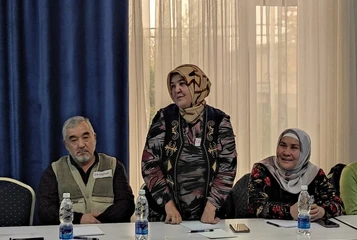
At the start of the intervention, several local committees responsible for the protection from domestic violence were either inactive or had limited capacity. Through a series of engagement meetings with local authorities, service providers and community representatives, these structures were either established or reactivated.
As a result, 10 local committees were created or strengthened, bringing together representatives of local self-government, law enforcement, social services and community leaders. These committees became key platforms for coordination, early identification of risks and referral of survivors to appropriate services.
Building capacity and improving coordination
To ensure the effectiveness of these mechanisms, the project invested in capacity building.
Members of local committees participated in targeted trainings on legal frameworks, prevention strategies, referral pathways and the principle of “do no harm”. In parallel, four crisis centres received specialised training and methodological guidance on how to work more effectively with local committees.
This contributed to improved coordination between community actors and service providers, as well as more structured and responsive support systems at the local level.
Providing direct support to survivors
Alongside system-level strengthening, the project provided direct assistance to individuals affected by violence.
Mobile teams of lawyers and psychologists conducted outreach visits across target municipalities, offering both individual consultations and group sessions.
Over the course of the project:
- more than 240 survivors received legal and psychological support;
- in total, over 1,200 people accessed consultations, awareness sessions and information on available services and rights.
Consultations addressed a wide range of issues, including domestic violence, legal rights, access to social protection, documentation and family disputes.
These services helped not only to respond to immediate needs but also to increase awareness of available protection mechanisms.
Working with communities and shifting norms
Recognising the role of social norms in perpetuating violence, the project engaged directly with communities through awareness-raising activities and dialogue.
Information sessions and discussions were conducted with residents across target municipalities, helping to increase understanding of legal protections and available support services.
In addition, preventive visits were organised in schools, reaching:
- 500 students and
- 150 parents,
with a focus on early marriage, gender equality and prevention of violence.
These activities contributed to raising awareness among young people and families, while also opening space for dialogue on sensitive issues.
From local action to sustainable change
Beyond immediate activities, the project supported the development of longer-term, institutionalised approaches.
Local committees developed and adopted work plans, and in several municipalities, funding for prevention activities began to be allocated from local budgets.
In total, 9 local нормативных актов и документов were adopted to regulate gender equality and violence prevention efforts, with further processes initiated for subsequent years.
These steps marked an important shift towards embedding prevention mechanisms within local governance structures.
Results and impact
Over the course of implementation, the project contributed to:
- strengthening 10 local prevention mechanisms;
- improving coordination between communities and service providers;
- providing support to hundreds of survivors;
- increasing awareness among over 1,900 community members;
- preventing at least 60 cases of violence at the local level.
Towards safer and more resilient communities
The project demonstrated that sustainable prevention of gender-based and domestic violence requires both strong local systems and empowered communities.
By combining capacity building, direct support and community engagement, the initiative helped lay the foundation for more responsive, inclusive and locally owned approaches to preventing violence.
As local actors continue to build on these efforts, the strengthened mechanisms and increased awareness provide a basis for longer-term change — contributing to safer and more resilient communities across southern Kyrgyzstan.